Veterans with serious service-connected disabilities may qualify for more than one federal benefit program. However, receiving disability compensation from the Department of Veterans Affairs (VA) does not automatically mean a veteran will qualify for Social Security Disability Insurance (SSDI). Each program has its own definition of disability, eligibility requirements, and application process.
For veterans who can no longer maintain substantial employment because of a disabling condition, understanding how these programs interact can be an important part of financial planning. The rules are particularly relevant for veterans with a VA rating of 100% Permanent and Total (P&T), because the Social Security Administration (SSA) provides expedited processing for qualifying disability claims.
VA disability compensation is generally based on the severity of service-connected conditions and their relationship to military service. Social Security disability benefits, by contrast, focus primarily on whether a medically determinable impairment prevents an individual from performing substantial work for at least 12 months or is expected to result in death.
This distinction means a veteran can receive VA compensation without qualifying for SSDI, and a person may qualify for Social Security disability benefits without having a VA disability rating.
The SSA specifically notes that VA and Social Security programs serve different purposes and apply different eligibility standards.
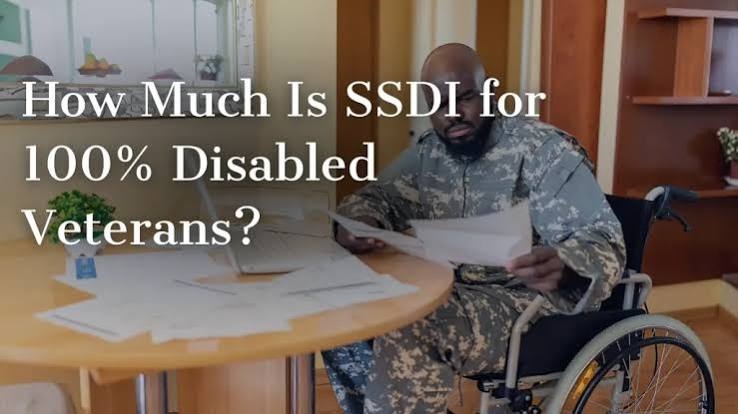
The phrase SSDI for 100 disabled veterans generally refers to veterans who have a 100% VA disability rating and are exploring eligibility for Social Security disability benefits.
A 100% VA rating can be especially significant when it is classified as Permanent and Total. The SSA has a special process for veterans with a 100% P&T VA disability compensation rating. These claims can receive priority processing after the agency verifies the qualifying rating.
However, the VA rating does not guarantee approval for SSDI. The SSA must independently determine whether the claimant satisfies its disability requirements.
Expedited processing is one of the most important benefits available to qualifying veterans applying for Social Security disability.
When the SSA identifies a veteran as having a qualifying 100% P&T VA compensation rating, the claim can be flagged for priority handling. The agency may identify eligible veterans through data matching with the VA, or the claimant may provide documentation confirming the rating.
This process is designed to move qualifying claims through the disability determination system more quickly. It does not eliminate the medical and vocational requirements that apply to other disability applicants.
A veteran seeking SSDI generally needs to establish that a qualifying medical impairment prevents substantial work activity and is expected to last at least 12 months or result in death. The applicant must also have sufficient work history for Disability Insurance benefits.
Evidence may include:
Strong documentation can help decision-makers understand not only the diagnosis but also how the condition affects a person's ability to work.
No. This is one of the most important points applicants should understand.
A 100% P&T VA rating can qualify a veteran for expedited Social Security processing, but it does not automatically establish eligibility for disability benefits. The SSA evaluates the claim using its own legal and medical standards.
For example, the VA may determine that several service-connected conditions justify a particular disability rating, while the SSA may focus on whether those conditions prevent substantial gainful work under its rules.
Therefore, veterans should avoid assuming that the VA decision alone will determine the outcome of a Social Security claim.
Veterans can apply for Social Security disability benefits through the SSA. When applying, a veteran with a qualifying 100% P&T VA compensation rating should identify that status and provide the appropriate VA notification documentation.
The SSA's current guidance states that applicants can apply online, by telephone, or through a local Social Security office. Veterans who apply online should identify themselves as "Veteran 100% P&T" in the remarks section when applicable.
Submitting complete information at the beginning can also reduce delays caused by requests for missing documentation.
A disability claim is about more than a diagnosis. Decision-makers need to understand how an impairment affects functional capacity and the ability to sustain employment.
For example, evidence may need to address limitations involving:
Vocational evidence can be particularly valuable when the question involves whether an individual can return to previous employment or adjust to other work.
In 2026, applicants increasingly have access to extensive electronic medical records, digital treatment histories, and detailed employment documentation. These resources can make it easier to present a complete picture of a claimant's limitations, but they also require careful organization.
Veterans should review their records for consistency and ensure that important medical and vocational information is accurately represented. A well-documented claim can make it easier for disability evaluators to understand the connection between medical limitations and workplace functioning.
Veterans with severe disabilities may be eligible for both VA compensation and Social Security disability benefits, but the two programs should be viewed separately. A 100% P&T VA rating can provide an important procedural advantage through expedited Social Security processing, yet approval still depends on meeting SSA's independent requirements.
For veterans exploring SSDI for 100 disabled veterans, the most effective approach is to understand the differences between the programs, provide complete medical and work information, and identify the qualifying VA rating during the application process. Careful preparation can help ensure that the claim receives the appropriate consideration while avoiding the misconception that a VA rating automatically guarantees Social Security approval.

This post has been authored and published by one of our premium contributors, who are experts in their fields. They bring high-quality, well-researched content that adds significant value to our platform.







Trending Buzz is your trusted source for trending news, viral stories, entertainment, technology, lifestyle, and informative content. Discover what's buzzing around the world every day.